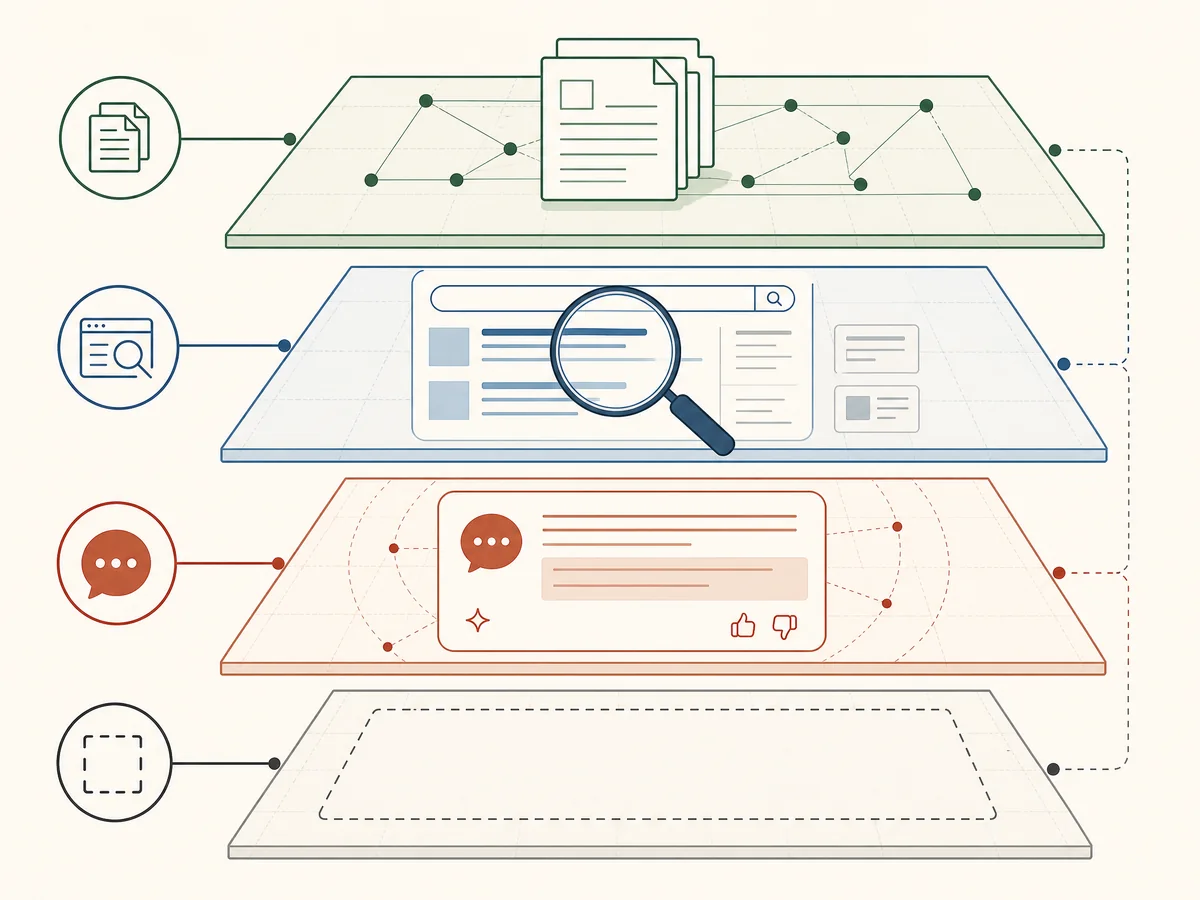
Illustrative field view: a technical surface, a search measurement, and an observation record are related, but they are not the same evidence.
GEO pathway · foundation 06
Measure the system you built.
Crawlability is a condition. A ranking is an outcome. A citation is an observation. An answer is a context-dependent event. This lesson teaches you how to measure each one without turning a clean technical audit into a story it cannot support.
Learning boundary. This is an evaluation method, not a visibility promise. It does not guarantee rankings, citations, retrieval, conversion, or inclusion in any search or answer system. It teaches you how to make a claim proportional to its evidence.
Why this matters
The same word—“visibility”—can hide four different questions.
A site owner may say, “We improved visibility,” when they actually mean one of four things: a crawler can reach the page; Google indexed or displayed the page; a person clicked it; or an answer system mentioned it in a particular context. Those are related but non-identical events. Treating them as interchangeable creates bad decisions and makes a technical team report success before the audience has experienced any change.
Google’s Search Console guidance separates discovery, indexing, Search performance, structured-data status, security, and page experience into different reports [1]. That separation is useful beyond Google: each measurement should answer one question, have a named source, and carry a boundary around what it cannot establish.
Learning objective
Build a measurement plan that survives scrutiny.
Figure 1. The four evidence layers used in this lesson. The labels and definitions live in the table below; the image is an explanatory visual, not a data visualization.
After this lesson, you should be able to explain the difference between a structural check, a platform metric, an independent observation, and an unknown; choose the right instrument for a question; record enough context for another person to reproduce the observation; and write a release statement that does not overclaim.
Evidence class
Plain-language definition
Example instrument
Safe statement
Structural check
A property of the published surface that can be inspected directly.
HTTP fetch, link crawler, canonical check, sitemap comparison.
“All 54 inspected routes returned 200 and were reachable within two clicks.”
Platform metric
A measurement reported by a platform operating a search or distribution surface.
Search Console Performance or indexing reports.
“The verified property reported 1,240 impressions during this date range.”
Independent observation
A dated, contextual record of what a person or answer system displayed.
“This query produced this response in this context on this date.”
Unknown
An outcome for which the appropriate evidence has not been collected.
Not a metric; a deliberate state in the claim register.
“Citation growth and Domain Authority are unknown.”
01 · Find and read
Can the system be crawled?
Inspect status codes, HTML anchors, robots directives, canonicals, sitemap parity, and rendered resources. A passing result says the public surface is technically available to a crawler. It does not say that the page is valuable, indexed, or authoritative.
02 · Index and display
What does the search platform report?
Use first-party tools for indexing and performance. Search Console can show impressions, clicks, queries, pages, countries, and trends, but the property, date window, filters, and report definitions must travel with the number [1].
03 · Inspect the answer
What appeared in a real context?
Record the exact question, date, locale, device, surface, model where known, full response, cited links, and whether the answer changed. Do not turn one screenshot into a stable score or a universal claim about “the model.”
04 · Name the unknown
What has not been measured?
Keep rankings, citations, traffic, conversions, independent backlinks, Domain Authority, and answer inclusion separate. If the instrument has not been run, the correct result is unknown—not an optimistic inference.
Concept lesson
Structural health is necessary, not sufficient.
Imagine a library. A crawlable link is a shelf label that lets a visitor reach a book. A canonical URL is the library’s decision about which edition is the reference copy. A sitemap is a catalogue supplied to the librarian. Structured data is a description of the book’s type and properties. None of these signals tells you that readers will choose the book, that a reviewer will cite it, or that a recommendation engine will mention it.
This is why our technical audits report conditions rather than outcomes. Google recommends checking that it can find and read pages, submitting or monitoring a sitemap, reviewing indexing coverage, and using the Performance report for impressions and clicks [1]. The measurement plan must preserve those layers instead of blending them into one “SEO score.”
“Risk management should be continuous, timely, and performed throughout the AI system lifecycle.” — NIST AI RMF Core [2]
We apply the same logic to GEO: measure the public knowledge surface continuously, map the context around a claim, record the observation, and manage correction when the record becomes stale. NIST’s Govern, Map, Measure, and Manage functions are a useful external framework for this rhythm, but this lesson’s worksheet is a Coreweaver interpretation, not a NIST certification or required checklist [2].
Worked example · a release with clean structure
What can the team honestly say?
A team publishes a 54-page learning site. Every route returns HTTP 200. Its sitemap matches the route manifest. Internal links are ordinary HTML anchors with no restrictive relationship attributes. No route is orphaned, and the maximum path from home is two clicks. The team has not connected Search Console, collected a backlink baseline, or run a documented answer-observation study.
Step one: write the supported claim
Supported: “As of the audit date, the inspected public route graph was reachable, its declared canonical and crawl controls were internally consistent, and its internal links were not marked with restrictive relationship attributes.”
Step two: reject the tempting claim
Not supported: “The site now ranks better, has higher Domain Authority, earns more citations, receives more traffic, or is more likely to appear in AI answers.” Those may become testable questions, but this structural audit did not measure them.
Step three: choose the next instrument
Verify the property in Search Console and establish a dated baseline for indexing, impressions, clicks, queries, and pages. Then define an independent observation protocol for answer surfaces if answer visibility is a real decision. Treat each protocol as a separate evidence stream.
Copy this four-column worksheet into your release notes.
Do not fill a field with a guess. If the source is missing, write unknown and name the instrument that would resolve it.
Layer
Question and scope
Evidence to attach
Boundary / next action
Structure
Which routes, links, canonicals, robots rules, sitemap entries, and schema blocks were checked? What date and commit?
Audit JSON, route manifest, commit URL.
Does not establish rankings or authority. Fix any failed route or control.
Search
Which verified property, date range, country, device, query, and page filters were used?
Search Console export or recorded report state.
Does not establish AI-answer inclusion. Compare equivalent periods.
Answer observation
What exact question, locale, device, surface, model, timestamp, response, and cited sources were recorded?
Observation packet with response and links.
One observation is not a universal score. Repeat across a defined sample.
Authority
What independent referring domains, citations, or third-party mentions were measured, and with which tool?
Dated backlink/referring-domain export and methodology.
Unknown until measured. Do not substitute a technical pass for off-site authority.
Practice prompt: Complete the Structure row for this lesson. Then write one Search question that could be answered by Search Console and one Answer question that would require a dated observation packet. If a learner cannot name the instrument, the question is not ready to measure.
Evaluation design
Use a measurement ladder, not a vanity score.
Figure 2. A measurement ladder: start with cheap repeatable structural checks, then move toward slower context-rich observations when the decision requires them.
A useful evaluation process moves from cheap, repeatable checks to slower, context-rich observations. Run the first rung on every release. Run the later rungs when the decision justifies the effort.
Rung
When to run it
Output
Failure response
1. Route and link check
Every commit that changes routes or navigation.
Status map, broken-target list, click-depth graph.
Repair the route or link before release.
2. Index and metadata check
Every release; after migrations or template changes.
Canonical, robots, sitemap, JSON-LD, and title/description report.
Fix conflicting or missing signals; do not infer an outcome.
3. First-party search baseline
After property verification and on a chosen cadence.
Date-bounded impressions, clicks, queries, pages, and indexing state.
Investigate trend changes with equivalent filters.
4. Contextual answer study
When a real decision depends on answer-system behavior.
Repeatable question sample and dated response packets.
Compare context and sources; do not generalize from one output.
5. Authority and outcome review
When off-site growth or business outcomes are in scope.
Referring-domain, citation, conversion, or qualified-lead evidence.
Keep the outcome separate from the technical release record.
NIST AI RMF Core. Govern, Map, Measure, and Manage functions; iterative risk-management context and the distinction between a framework and an ordered checklist.